FODMAP reintroduction, also called the challenge phase, is the second phase of the low-FODMAP diet. While the rest of your diet stays low in FODMAPs, you test one FODMAP group at a time, usually eating one test food in increasing amounts over three days and watching for symptoms. The aim is to find out which FODMAPs you can eat, and how much of them, so you can return to the widest diet that keeps your IBS under control.[1]
What is FODMAP reintroduction and why does it matter?
Elimination tells you whether FODMAPs as a whole affect your symptoms. It doesn't tell you which ones. Reintroduction answers that question. It's how you identify your specific triggers, shrink the list of foods you avoid, and bring prebiotic fibers back into your diet.[2] Tolerance often differs from one FODMAP group to another, between people, and within the same person over time.[1]
There's surprisingly little research on this phase. A 2018 review found no randomized trials of reintroduction itself, so current practice combines limited research with clinical experience.[1] The studies that do exist are reassuring. In a New Zealand trial, symptom improvements were maintained while people reintroduced FODMAP foods, and their fiber intake, which had dropped during elimination, rose again.[3] In a UK clinic, 57% of patients still had satisfactory symptom relief at long-term follow-up after reintroduction.[4]
When should you start reintroducing FODMAPs?
Start once the elimination phase has clearly helped and your symptoms are stable. That usually takes a few weeks of strict restriction (see our low-FODMAP diet guide). If you followed elimination carefully and your symptoms didn't improve, the diet hasn't worked for you. Don't move on to formal challenges. Gradually return to your normal diet and talk to your doctor about other treatments.[1]
How does a FODMAP challenge work, step by step?
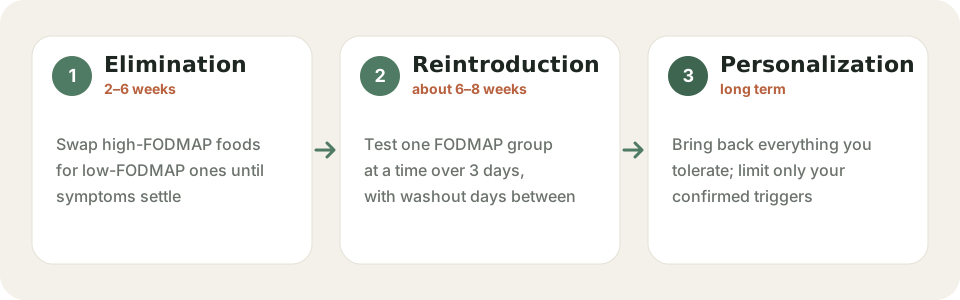
- Keep your baseline low-FODMAP. Everything you eat apart from the test food stays low in FODMAPs, so any change can be traced to the challenge.[1]
- Choose one test food that's high in just one FODMAP group. Mango, for example, tests excess fructose. A food that contains several FODMAPs can't tell you which one caused a reaction.[1]
- Eat it in increasing amounts over three days. Start with a small portion on day 1 and build up on days 2 and 3. Your dietitian can suggest suitable amounts for each food.[1][2]
- Record what happens. Note any symptoms, how severe they are and when they start, plus your stool form. Fructose tends to cause symptoms sooner than fructans, which act later in the colon,[5] so keep logging into the evening and the next morning.
- Stop early if symptoms clearly flare. If your symptoms increase substantially during the three days, end that challenge.[1]
- Take washout days. Go back to strict low-FODMAP eating, typically for about three days, until symptoms settle before the next challenge. That keeps one test from spilling into the next. If a challenge caused no symptoms at all, you can move straight on.[1]
- Repeat for the next group until you've tested all six, plus any foods you particularly miss.[1]
Which foods are used to test each FODMAP group?
These are common choices. The best test foods are ones you actually want to eat again, so a dietitian will often tailor the list to your tastes and cuisine.[2][1]
| FODMAP group | Common test foods | Notes |
|---|---|---|
| Fructans | Wheat bread, onion, garlic | Test these separately. Fructans differ in structure, so tolerating bread doesn't mean you'll tolerate onion.[1] |
| GOS | Lentils | Other pulses such as chickpeas are also rich in GOS.[6] |
| Lactose | Milk | Yogurt is another common lactose source.[7] |
| Excess fructose | Mango | Honey is another option.[1] |
| Sorbitol | Apricot | Avoid apples and pears for this test because they contain more than one FODMAP.[7][1] |
| Mannitol | Mushrooms | Cauliflower is another mannitol source.[1] |
How do you read your reintroduction results?
Judge each challenge against your normal baseline, not against a perfect day. As a rough guide:[1]
- No change over all three days: you tolerated that group at the amounts you tested. Wait to add it back permanently until you've finished all your challenges, so it doesn't muddy later tests.
- Mild symptoms only on day 3: your threshold is somewhere below the largest portion. Small portions now and then are likely to be fine.
- Clear symptoms from day 1: that group is probably a strong trigger for you, and you may need to limit it closely for now.
A result describes a dose, not a permanent yes or no. Your response can shift with the total FODMAP load of a meal, the fat and fiber eaten with it, stress, and how sensitive your gut is that week.[1] Tolerance can also change over time, so foods that failed are worth retesting later.[6]
Common reintroduction mistakes to avoid
- Testing two groups at once. Apples, for example, contain both sorbitol and excess fructose.[1][7] Test single-FODMAP foods first and combinations later.[1]
- Skipping the washout. Symptoms that carry over from one challenge make the next one impossible to read.[1]
- Testing only one fructan food and concluding that all fructans are out.[1]
- Testing in a bad week. A stomach bug, a stressful deadline or your period can all worsen IBS symptoms on their own. In women with IBS, for example, menstruation has been linked to more pain, bloating and gut sensitivity.[8] If a challenge coincides with one of these, repeat it later.
- Letting expectation decide. FODMAP challenges are prone to the nocebo effect, where expecting a reaction can produce symptoms by itself.[1] If a result surprises you, repeat it before cutting the food for good.
- Never starting. In a real-world study, fewer than half of patients carried out the reintroduction phase properly. Those supported by a dietitian were much more likely to do so (70% vs 39%).[9]
From reintroduction to personalization
Once your challenges are done, you move to the third phase. You eat freely the foods and groups you tolerated, keep your triggers at amounts that suit you, and aim for a diet that is as close to normal, varied and enjoyable as possible.[1] Spread higher-FODMAP foods across the day rather than stacking several in one meal, because the total load per meal matters.[1] Avoid "FODMAP binges," and every so often retest the foods you didn't tolerate.[6]
A personalized diet also seems better for your gut bacteria. In one follow-up study, bifidobacteria levels were similar to baseline after a year on a personalized diet, and two-thirds of patients reported adequate symptom relief.[10] A simple food and symptom diary helps you keep an eye on things as you go.