AI can take over the most tedious parts of managing irritable bowel syndrome (IBS): working out what is in a meal, estimating its FODMAP content, and spotting links between what you eat and how you feel. It can’t diagnose IBS or replace a structured food reintroduction. The most useful AI tools for IBS make the evidence-based low-FODMAP process easier to follow — and are honest about what they don’t know.
What can AI do for IBS?
The low-FODMAP diet is one of the few dietary approaches for IBS backed by clinical guidelines[1][2], and it works best when restriction is followed by careful reintroduction[3]. The hard part is the bookkeeping: knowing what you ate, which FODMAP groups it contained, and how you felt hours later — every day, for weeks. That is where AI helps:
- Recognizing meals. From a photo or a short description, image and language models can name a dish and list its likely ingredients — in seconds instead of minutes of typing.
- Estimating FODMAPs. Each ingredient can be mapped to the six FODMAP groups (fructans, GOS, lactose, excess fructose, sorbitol and mannitol) and combined into an estimate for the whole meal.
- Catching hidden ingredients. Garlic in a marinade, onion in a stock, wheat in a batter or honey in a dressing are the ingredients people most often miss. A model that knows how a dish is usually cooked can flag them.
- Finding patterns. Statistics can compare meals that contain a FODMAP group with meals that don’t, across weeks of data — something that is very hard to do by eye.
- Summarizing for your clinician. Weeks of logs can be turned into a one-page report a doctor or dietitian can read quickly.
What AI can’t do
- Diagnose IBS. IBS is diagnosed by a clinician using the Rome IV criteria and, where needed, tests that rule out other conditions[4]. Symptoms such as blood in the stool or unexplained weight loss need a doctor, not an app — see IBS red flags.
- Give exact FODMAP amounts. Recipes, brands and portions vary. AI estimates are good enough to guide a diary, not a substitute for laboratory food analysis.
- Prove a food is a trigger. A pattern in your diary is a suspect, not a verdict. The way to confirm it is a structured reintroduction: one group at a time, in increasing amounts, while everything else stays low-FODMAP[3].
- Replace a dietitian. Guidelines recommend the low-FODMAP diet be supervised by a trained dietitian where possible[2]. A good app makes that support more effective; it doesn’t remove the need for it.
General chatbots vs. a dedicated IBS app
Chatbots are good at explaining what FODMAPs are or suggesting a low-FODMAP swap. But they don’t keep a structured, time-stamped record of your meals and symptoms, they can’t run statistics on it, and they can state wrong facts with confidence. A dedicated IBS app stores your data in a structure built for the question “what is triggering my symptoms?”, applies the same FODMAP model to every meal, and can show its working.
How to choose an AI app for IBS: a checklist
- FODMAP-specific. It estimates all six FODMAP groups — not calories or “gut scores”.
- Hidden ingredients. It looks beyond the dish name for garlic, onion, wheat and sweeteners, and lets you correct it.
- Timing and stacking. It links symptoms to meals within a sensible window and accounts for FODMAPs adding up across meals.
- Uncertainty. It reports probabilities and how much data they rest on, rather than declaring a trigger after one bad day.
- The whole plan. It supports elimination, reintroduction and personalization — not just a list of “bad foods”.
- Validated measures. It tracks progress with standard tools such as the IBS-SSS and the Bristol Stool Form Scale.
- Safety. It screens for alarm features and tells you when to see a doctor.
- Something to show your clinician. It exports a clear report.
- Privacy. It collects the minimum, asks before sending anything to an AI service, and has no ads or third-party tracking.
- Your language and cuisine. It understands the food you actually eat.
How IBS Clue works
IBS Clue is an iPhone app that we built around the checklist above. Here is exactly what it does with your data.
1. Meal analysis
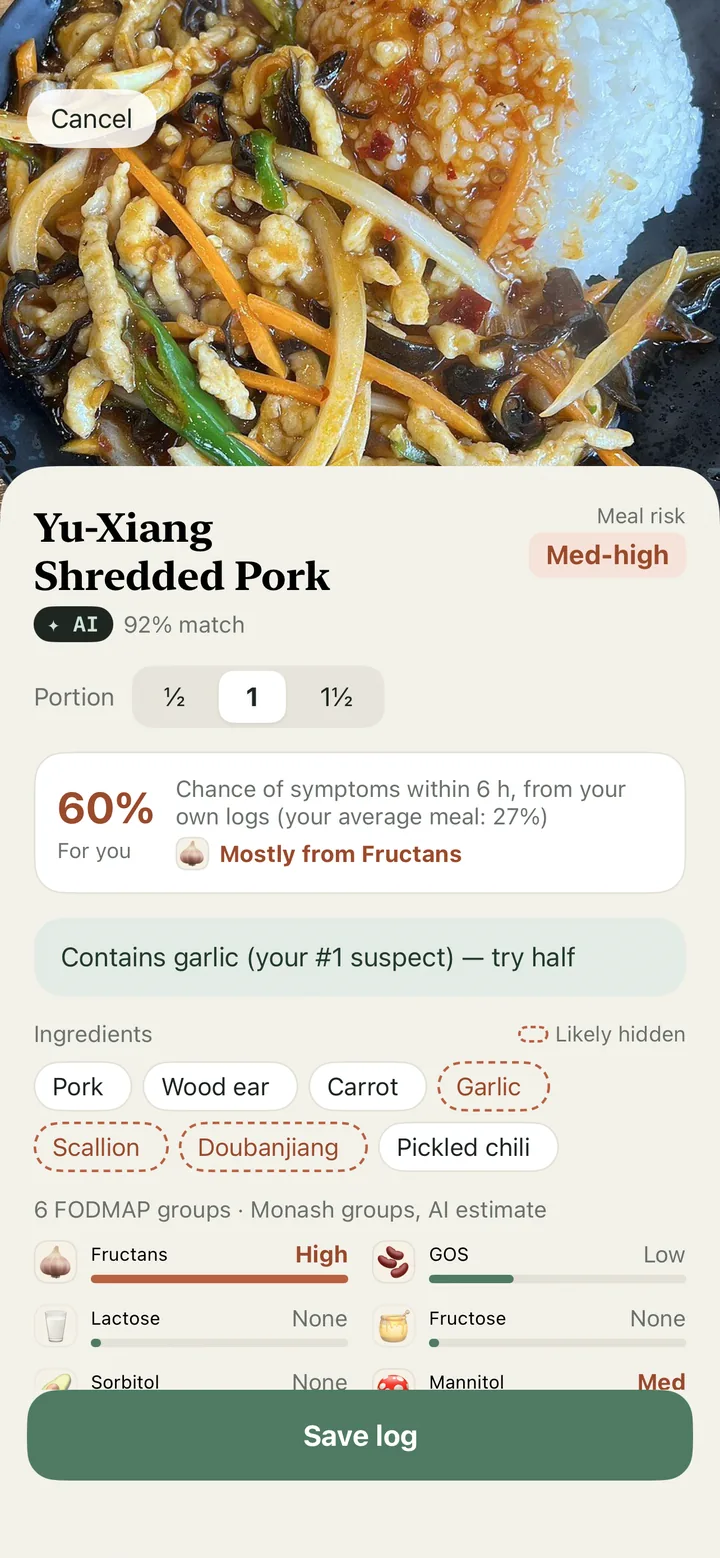
You photograph a meal (up to four photos) or describe it. The AI identifies the dish and its ingredients, marks the ones that are likely hidden, and estimates the level of each FODMAP group for the meal — none, low, medium or high — along with a short tip. You can tap any ingredient to correct or remove it, and the meal is analyzed again with your fix. Portion size (half, one, one and a half) scales the estimate.
2. Check-ins and stool logs
Twice a day you record how you feel — all good, or bloating, pain, diarrhea, constipation, gas or fatigue with a severity — and you can log stool form on the Bristol scale. Your stool logs also give your IBS subtype under Rome IV once there are enough of them[4].
3. The trigger model
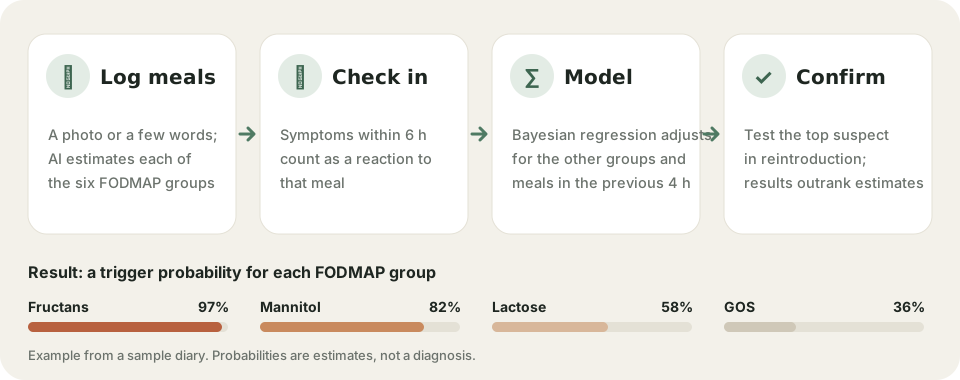
- Labelling meals. A symptom within 6 hours of a meal marks it as a reaction. A later check-in with no symptoms in that window marks it as fine. Meals with no check-in at all are left out — no log is not the same as no symptoms.
- Adjusted model. A Bayesian logistic regression uses the six FODMAP group levels of each meal plus the FODMAP load from meals in the previous 4 hours, so groups that turn up together don’t share the blame. Each group gets an odds ratio with a 90% credible interval, and a trigger probability: the posterior probability that the group raises your risk.
- Honesty checks. A raw comparison (symptom rate after medium/high doses vs. other meals), a dose–response check and a leave-one-out accuracy check sit alongside the model, and “See how it’s worked out” shows every step. Conclusions wait until there are enough labelled meals.
- Reintroduction wins. When you test a group in a reintroduction challenge, that result outranks the statistical estimate.
4. The three-phase plan
IBS Clue guides elimination (usually 2–6 weeks), then reintroduction — one FODMAP group at a time, with three increasing doses of a test food over three days — and finally personalization, where you keep limiting only what you have confirmed[3]. It measures progress with the IBS-SSS at the start and in weekly re-checks, plus a weekly “adequate relief” question.
5. Safety, reports and privacy
At sign-up it asks about alarm features and advises seeing a doctor if any apply. It exports a PDF report with your scores, suspected triggers and the statistics behind them, a symptom chart and a day-by-day log. There is no account; your diary stays on your phone. Before the first AI analysis, the app explains what is sent and asks for your consent; your name, age, alarm features and symptom logs are never sent.
How IBS Clue compares
| IBS Clue | Paper food diary | Calorie / food tracker | FODMAP food guide | |
|---|---|---|---|---|
| Logs a meal from a photo | Yes | No | Often | No |
| Estimates all six FODMAP groups, incl. hidden ingredients | Yes | No | No | Look up each food |
| Links symptoms to meals with timing and stacking | Yes | By hand | No | No |
| Ranks personal triggers with probabilities | Yes | No | No | No |
| Guides elimination → reintroduction → personalization | Yes | No | No | Varies |
| Doctor-ready report | Yes | The notebook | Varies | Varies |
| No account; data stays on the phone | Yes | Yes | Rarely | Varies |
Limitations we want you to know
- FODMAP levels are AI estimates and can be wrong — especially for unfamiliar dishes. Correct them when you can.
- Trigger probabilities need data: a couple of weeks of meals with check-ins. Early results are labelled as early.
- Symptoms have causes besides food — stress, sleep, hormones, illness. The model only sees what you log.
- IBS Clue is a self-tracking tool, not a medical device. It doesn’t diagnose or treat, and it isn’t a substitute for a doctor or dietitian.
The low-FODMAP approach itself is well studied: in a controlled trial, people with IBS had lower overall symptom scores on a low-FODMAP diet than on a typical diet[5]. IBS Clue’s job is to make that approach easier to follow — and to help you find out which parts of it matter for you.