The IBS Symptom Severity Score (IBS-SSS) is a short five-item questionnaire that rates IBS on a scale from 0 to 500. In the original validation, scores of 75–175 indicated mild IBS, 175–300 moderate and over 300 severe, while healthy people scored below 75. A drop of 50 points or more reliably signals a meaningful improvement.[1]
What is the IBS-SSS?
The IBS-SSS (also called the IBS severity scoring system) was developed by Francis, Morris and Whorwell at University Hospital of South Manchester in the UK, and published in 1997. It was validated in 141 patients with IBS and 40 healthy controls. Scores repeated within 24 hours were very reproducible, and the score was sensitive to change over time.[1]
It is still in use today. UK gastroenterology guidelines list it among the validated systems for assessing the impact and severity of IBS symptoms.[4] It covers pain, bloating, bowel dysfunction and quality of life,[1] so it captures more than just how much it hurts.
What are the five IBS-SSS questions?
Four items are rated on a visual analogue scale, a line from 0 to 100 on which you mark how you feel. The fifth counts days.[2][3]
| Item | What it measures | How it's scored |
|---|---|---|
| 1. Pain severity | How severe your abdominal pain is | 0–100 on the line |
| 2. Pain frequency | On how many of the last 10 days you had abdominal pain | Number of days × 10 (0–100) |
| 3. Bloating | How severe your abdominal distension or bloating is | 0–100 on the line |
| 4. Bowel habit dissatisfaction | How unhappy you are with your bowel habits | 0–100 on the line |
| 5. Life interference | How much IBS is affecting or interfering with your life in general | 0–100 on the line |
If you have no abdominal pain at all, items 1 and 2 both score 0, and your total comes from the other three items.
A few habits make your answers more reliable. Stick to the time frame each question asks about, and count pain days carefully, perhaps from a diary. Try not to look at your previous score before you mark the lines. You want each result to reflect how you feel now, not how you think you should be doing.
How is the IBS-SSS scored?
You add the five item scores together. Each item can contribute up to 100 points, so the total ranges from 0 to 500. Higher scores mean more severe symptoms.[1][2]
A worked example:
- Pain severity: 60
- Pain on 5 of the last 10 days: 5 × 10 = 50
- Bloating: 70
- Bowel habit dissatisfaction: 80
- Life interference: 60
The total is 60 + 50 + 70 + 80 + 60 = 320, which falls in the severe range. The five items carry equal weight, so bloating or the effect on daily life can raise your score as much as pain does.
What do IBS-SSS scores mean?
| Total score | Interpretation |
|---|---|
| Below 75 | The range of healthy controls. In someone with IBS, considered remission |
| 75–175 | Mild IBS |
| 175–300 | Moderate IBS |
| Over 300 | Severe IBS |
These cut-offs come from the original 1997 paper, which found significant differences between all the severity categories.[1] Later work by one of the original authors notes that a score below 75 includes 95% of a non-IBS population.[3]
What change in IBS-SSS is clinically meaningful?
The original study found that a change of 50 points reliably indicates improvement.[1] Researchers use that 50-point drop to define a treatment "responder." For example, a hypnotherapy study from the same Manchester group did so, and also reported stricter thresholds of 100 and 150 points.[3]
Other definitions exist alongside it. The US Food and Drug Administration has suggested defining a responder in IBS as someone whose pain score falls by at least 30%.[3] So a fall of 50 points or more in your total is a good sign that a change is helping. If your score climbs by a similar amount, take that as a prompt to review things with your doctor.
How can you use the IBS-SSS to track your progress?
- Take a baseline first. Score yourself before you start a new diet, therapy or medicine, so you have something to compare against.
- Repeat at a steady interval. The pain-frequency item looks back over 10 days, so retesting every week or two at consistent times gives comparable snapshots.
- Look at the items, not just the total. A falling total with stubborn bloating tells a different story from one where pain improves but life interference doesn't.
- Change one thing at a time where you can, so you know what made the difference. This matters during the low-FODMAP diet and reintroduction.
- Pair it with a diary. Your score shows how much things changed. A food and symptom diary helps show why.
- Share the trend with your doctor. A series of scores is much easier to act on than "a bit better, I think."
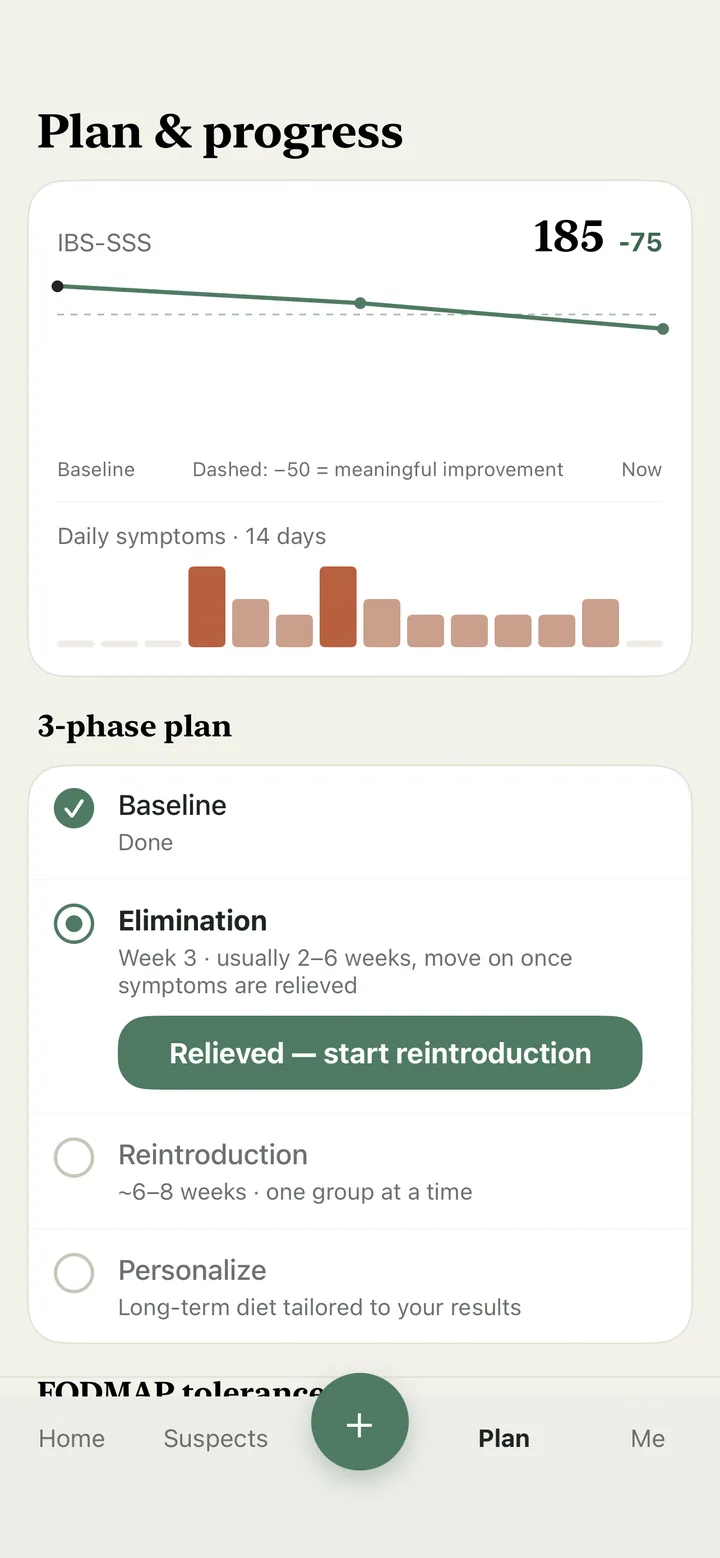
IBS Clue, an iPhone app coming soon, includes an IBS-SSS assessment with weekly re-checks, so you can see your trend next to your meal and symptom log. Like the questionnaire itself, it tracks symptoms and doesn't diagnose.
What are the limits of the IBS-SSS?
- It measures severity, not cause. A high score doesn't confirm IBS, and a low one doesn't rule out other conditions. It won't pick up alarm features such as bleeding or weight loss. See IBS red flags.
- It's self-reported. It reflects how you rate your own symptoms, so filling it in the same way and at similar times makes results easier to compare.
- The bands are rough guides. They come from one validation study, and research groups apply the boundaries slightly differently.[1][2]