Research on IBS and diet is stronger than many people expect. Randomized trials and meta-analyses show that a low-FODMAP diet, ideally guided by a dietitian and followed by reintroduction, improves symptoms for many people with IBS, and it has more trial evidence than any other IBS diet.[1][2] US and UK guidelines also support soluble fiber, peppermint oil, and gut-directed psychological therapies.[3][4]
Below are the studies that shaped how IBS is diagnosed, measured, and treated today: what each one did, what it found, and why it matters. The numbers come straight from the published papers, and every study links to its source in the list at the end.
How common is IBS?
About 1 in 10 adults: a global meta-analysis
Researchers pooled 80 population studies covering 260,960 adults to estimate how many people have IBS. The pooled prevalence was 11.2%, but it ranged from 1.1% to 45.0% depending on the country and the diagnostic criteria used. Women were more likely to have IBS than men (odds ratio 1.67), and people over 50 were less likely than younger adults (odds ratio 0.75). This is the study behind the widely quoted "1 in 10" figure.
Lovell RM, Ford AC. Clinical Gastroenterology and Hepatology, 2012.[5]
The Rome Foundation Global Study: stricter criteria, lower numbers
This survey of 73,076 adults in 33 countries used the Rome IV questionnaire to measure 22 disorders of gut-brain interaction, and 40.3% of internet respondents met the criteria for at least one. IBS prevalence was 4.1% under Rome IV versus 10.1% under the older Rome III criteria in the internet surveys, and 1.5% versus 3.5% in household interviews. It shows that how many people "have IBS" depends heavily on the definition used.
Sperber AD, Bangdiwala SI, Drossman DA, et al. Gastroenterology, 2021.[6]
Does the low-FODMAP diet work?
FODMAPs (fermentable oligo-, di-, monosaccharides and polyols) are short-chain carbohydrates that gut bacteria ferment. The low-FODMAP diet temporarily restricts them, then reintroduces them to find personal triggers.[7] Read the practical version in our low-FODMAP diet guide.
An early randomized trial: better symptom control, fewer bifidobacteria
At King's College London, 41 people with IBS were randomized to restrict fermentable carbohydrates or keep their usual diet for 4 weeks. In the intention-to-treat analysis, 68% of the diet group reported adequate symptom control versus 23% of controls. The diet also reduced bifidobacteria, a group of gut bacteria generally considered beneficial, and the authors said the long-term implications were still to be determined.
Staudacher HM, Lomer MC, Anderson JL, et al. Journal of Nutrition, 2012.[8]
A controlled feeding study: symptom scores roughly halved
Monash University researchers supplied almost all the food for 30 people with IBS, who ate a low-FODMAP diet and a typical Australian diet for 21 days each, in random order, with a washout in between. Overall symptom scores were 22.8 mm on the low-FODMAP diet versus 44.9 mm on the typical diet (on a 0–100 mm scale), with less bloating, pain, and wind. Because the researchers controlled what people ate, the study could compare the diets directly rather than relying on people following advice.
Halmos EP, Power VA, Shepherd SJ, Gibson PR, Muir JG. Gastroenterology, 2014.[9]
Low-FODMAP versus traditional IBS advice: a close race
This Swedish trial randomized 75 people with IBS to 4 weeks of either a low-FODMAP diet or traditional IBS dietary advice: regular meals, avoiding large meals, and cutting back on fat, insoluble fiber, caffeine, and gas-producing foods such as beans, cabbage, and onions. Symptoms improved in both groups with no significant difference, as 50% on low-FODMAP and 46% on traditional advice had an IBS-SSS drop of at least 50 points. It's a reminder that simpler first-line advice helps many people, which fits UK guidance to keep low-FODMAP as a second-line option.[4]
Böhn L, Störsrud S, Liljebo T, et al. Gastroenterology, 2015.[10]
How does low-FODMAP compare with other diets?
A network meta-analysis: low-FODMAP ranks first
Researchers combined 13 randomized trials with 944 patients, comparing a low-FODMAP diet with habitual diets, sham diets, and standard British Dietetic Association/NICE dietary advice. Low-FODMAP ranked first for overall symptoms (relative risk of symptoms not improving 0.67 versus a habitual diet), abdominal pain, and bloating, and it beat standard advice for bloating. The authors cautioned that most trials took place in specialist clinics and didn't study the reintroduction and personalization phases.
Black CJ, Staudacher HM, Ford AC. Gut, 2022.[1]
An updated analysis of 11 diets: most evidence, but rivals emerging
This 2025 analysis pooled 28 randomized trials (2,338 patients) testing 11 different diets. Low-FODMAP had by far the most trials (24) and, among diets tested in more than one trial, was the only one to beat a habitual diet for bloating; a starch- and sucrose-reduced diet ranked first for overall symptoms, but in only two trials. The authors concluded that the most evidence exists for low-FODMAP, while other promising diets deserve further study.
Cuffe MS, Staudacher HM, Aziz I, et al. Lancet Gastroenterology & Hepatology, 2025.[2]
What happens after elimination?
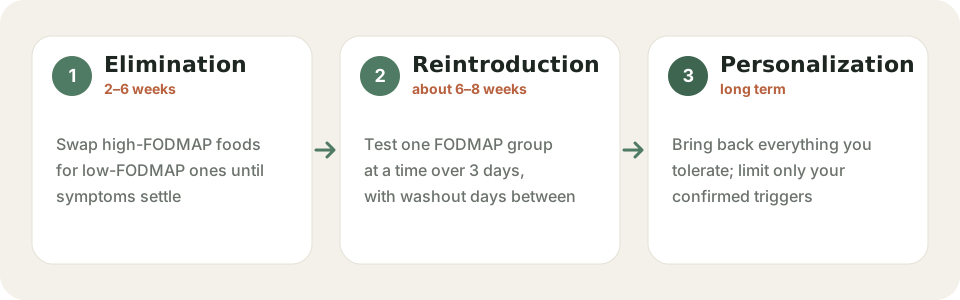
The three-stage model: restrict, reintroduce, personalize
This evidence-based review from King's College London set out how dietitians should deliver the diet in practice, over at least two appointments. It describes three stages: FODMAP restriction; FODMAP reintroduction, to identify the foods that trigger symptoms; and FODMAP personalization, a less restrictive long-term diet that excludes only personal triggers so you can eat a more varied diet. It's the framework behind the step-by-step approach in our reintroduction guide.
Whelan K, Martin LD, Staudacher HM, Lomer MCE. Journal of Human Nutrition and Dietetics, 2018.[7]
Long-term follow-up: relief lasts on a less strict diet
Researchers followed 103 people with IBS from dietitian-led low-FODMAP education through to the long term, after FODMAPs had been reintroduced. Satisfactory symptom relief was reported by 12% at baseline, 61% after restriction, and 57% at long-term follow-up, and 82% were following an adapted, less restrictive FODMAP diet. Nutritional adequacy wasn't compromised, although the adapted diet cost more and affected social eating.
O'Keeffe M, Jansen C, Martin L, et al. Neurogastroenterology & Motility, 2018.[11]
How is IBS measured?
The IBS Severity Scoring System (IBS-SSS)
UK researchers validated this questionnaire in 141 patients and 40 healthy controls. It combines ratings of pain, distension (bloating), bowel dysfunction, and quality of life into a score out of 500: 75 to 175 is mild, 175 to 300 moderate, and over 300 severe, while controls scored below 75. A change of 50 points reliably indicated improvement, which is the responder threshold used in trials such as the Swedish study above; see how to use the IBS-SSS.
Francis CY, Morris J, Whorwell PJ. Alimentary Pharmacology & Therapeutics, 1997.[12]
The Bristol Stool Form Scale tracks gut transit
In 66 volunteers, researchers measured whole-gut transit time with radiopaque markers, then sped it up with senna and slowed it with loperamide. Stool form on the 7-point Bristol scale correlated with transit time better than stool frequency or stool weight did (r = −0.54 at baseline, and −0.65 for changes in transit). That's why a simple log of your Bristol stool type is a meaningful way to monitor bowel function.
Lewis SJ, Heaton KW. Scandinavian Journal of Gastroenterology, 1997.[13]
Rome IV: the 2016 diagnostic criteria
The Rome IV committee defined IBS as recurrent abdominal pain, on average at least one day a week in the last three months, associated with two or more of: relation to defecation, a change in stool frequency, or a change in stool form, with symptoms starting at least six months before diagnosis. Compared with Rome III, it dropped "discomfort" and raised the pain frequency from three days a month to one day a week, and it classifies IBS by predominant stool pattern into IBS-C, IBS-D, IBS-M, and IBS-U.
Mearin F, Lacy BE, Chang L, et al. Gastroenterology, 2016.[14]
Which other IBS treatments have good evidence?
The American College of Gastroenterology guideline (2021)
The ACG's first IBS guideline graded the evidence on 25 clinical questions using the GRADE method. It recommends a limited trial of a low-FODMAP diet and soluble (not insoluble) fiber, suggests peppermint oil and gut-directed psychotherapy for overall symptoms, and suggests against probiotics, citing very low-quality evidence. It also favors a positive, symptom-based diagnosis, suggests celiac and fecal calprotectin tests when diarrhea is present, and advises against routine colonoscopy for people under 45 without warning signs.
Lacy BE, Pimentel M, Brenner DM, et al. American Journal of Gastroenterology, 2021.[3]
The British Society of Gastroenterology guideline (2021)
The BSG guideline reclassified IBS as a disorder of gut-brain interaction and based its recommendations on updated meta-analyses of diet, drug, and psychological treatments. First-line advice includes regular exercise and soluble fiber such as ispaghula (psyllium), started low and built up gradually, while insoluble fiber such as wheat bran should be avoided. A low-FODMAP diet is a second-line option supervised by a trained dietitian, probiotics may be tried for up to 12 weeks, peppermint oil may help, and IBS-specific CBT and gut-directed hypnotherapy are strongly recommended when symptoms persist.
Vasant DH, Paine PA, Black CJ, et al. Gut, 2021.[4]
Psychological therapies: CBT and gut-directed hypnotherapy
This network meta-analysis pooled 41 randomized trials with 4,072 participants. Self-guided or minimal-contact cognitive behavioral therapy (CBT), face-to-face CBT, and gut-directed hypnotherapy all reduced the chance of remaining symptomatic (relative risks 0.61, 0.62, and 0.67), and none was clearly better than another. The authors noted a high risk of bias, so the benefit may be overestimated, but CBT-based therapies and hypnotherapy had the largest evidence base.
Black CJ, Thakur ER, Houghton LA, et al. Gut, 2020.[16]
Do food diaries help find your triggers?
Most people with IBS suspect specific foods
In 197 people with IBS, 84% reported symptoms after at least one of 56 foods surveyed, and 70% linked symptoms to foods with incompletely absorbed carbohydrates, most often dairy (49%), beans and lentils (36%), apples (28%), flour (24%), and plums (23%). People with more severe IBS reported more problem foods and had lower quality of life. Self-report is a starting point rather than proof, which is why structured tracking and testing matter.
Böhn L, Störsrud S, Törnblom H, et al. American Journal of Gastroenterology, 2013.[17]
A food-and-symptom app is feasible, and patterns differ by person
In this small pilot, 11 people with IBS logged their meals and symptoms in a purpose-built smartphone app for two weeks, with high compliance and above-average usability scores. Individual analyses found at least one strong association between symptoms and a meal nutrient in 73% of participants, and the patterns differed from person to person. The study was too small to test whether app-guided changes improve symptoms, but it supports the idea that triggers are individual.
Zia J, Schroeder J, Munson S, et al. Clinical and Translational Gastroenterology, 2016.[18]
Blinded reintroduction reveals personal FODMAP triggers
In this Belgian trial, 80% of 117 patients responded to a 6-week low-FODMAP diet, and responders were then rechallenged in a blinded, random order with powders of six FODMAPs or a glucose control; a rise of at least 50 IBS-SSS points counted as a trigger. On average each person reacted to 2.5 FODMAPs, most often fructans (56%) and mannitol (54%), followed by galacto-oligosaccharides (35%), lactose (28%), fructose (27%), and sorbitol (23%). Notably, 26% also reacted to the glucose control, a reminder that not every reaction during reintroduction is caused by the food being tested.
Van den Houte K, Colomier E, Routhiaux K, et al. Gastroenterology, 2024.[19]
This is the logic behind IBS Clue's "Suspects" feature: it ranks the FODMAP groups most associated with symptoms in your own diary and gives a probability for each, but treats results from structured reintroduction as the stronger evidence. For a hands-on method, see how to keep an IBS food diary.
What does the research mean for you?
- Get a diagnosis first. See a doctor to confirm IBS, and promptly if you have warning signs such as unintentional weight loss, symptoms that start later in life, or a family history of bowel cancer or inflammatory bowel disease.[3]
- Start simple. Regular meals, soluble fiber, and exercise are first-line advice; low-FODMAP is a second-line step, best done with a registered dietitian.[4]
- Keep elimination short. The strict phase is meant to be temporary, followed by reintroduction and a personalized diet.[7] Talk to a professional before restricting your diet if you have, or are at risk of, an eating disorder, are pregnant, or are planning it for a child.
- Consider the gut-brain side. CBT and gut-directed hypnotherapy have the largest evidence base among psychological therapies for IBS, and they can be used alongside diet changes.[16]